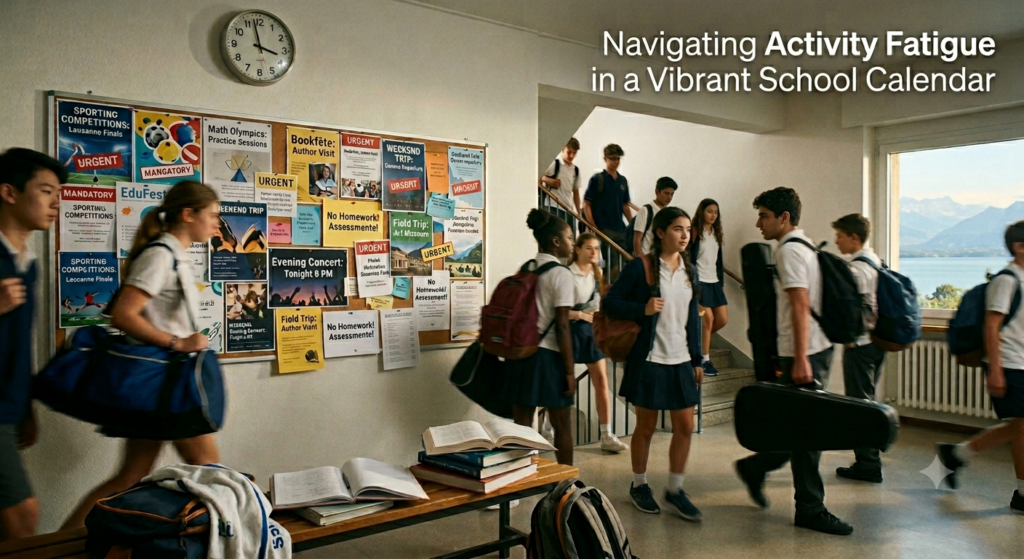
The end of year can be frantic for any educator. Not only can it feel like a “mad rush” to finish your units, leaving enough time for review before exams; we also have final assessments to mark and term grades to calculate, reports to enter, summer reading lists to compile, professional development projects to complete, initiatives for next year to sign off, year reflections and conversations with supervisors to schedule.
At our school, this term felt particularly hectic, and as I reviewed our calendar and emails announcing/reminding a series of events (sporting, artistic, special days, cultural visits, festivals, etc.), it led me to wonder to what extent disruptions to the regular academic week can have a negative impact on student learning. What studies have been conducted to measure the impact of missing a lesson, a day of school, an evening of homework, etc.? Special events can be a highlight of the school year, but is there a “threshold” after which the benefits are reduced because irregularities in the school schedule stop being “special”? Furthermore, can “special events” become disruptions that negatively impact learning?
I posed this question to two AI engines: Claude and Gemini. Below is a summary of their combined responses, organized under 4 headings. I pose a question for you at your schools, before the bibliography.
1. What does the research says about irregular absences to lessons? Is there actual data showing that minor, weekly disruptions impact student progress?
Yes. Extensive research (such as the work by education researcher John Hattie in his Visible Learning meta-analyses) shows that instructional time has a significant, positive correlation with student achievement. Educational research across Europe consistently shows a direct correlation between instructional continuity and student achievement. The OECD (Paris), through its extensive PISA data sets, emphasizes that while the sheer volume of school hours matters, the predictability and quality of those hours are paramount.
When individual students are repeatedly pulled out of class for competitions or early weekend departures (and to a lesser extent, when the whole group is disrupted by “special days”), they suffer from fragmented learning. Research from the Swiss Coordination Centre for Research in Education (CSRE) indicates that unpredictable variations in teaching time directly hinder a student’s ability to master cumulative subjects like mathematics and modern languages, where each lesson builds strictly upon the last.
2. What is “activity fatigue,” and what does science say about it?
Activity fatigue is the practical manifestation of Cognitive Load Theory, a framework deeply embedded in educational psychology. To consolidate learning, brains need boredom/ downtime, routine, and sleep. If evening events constantly push back bedtime or eliminate downtime, the brain cannot physically cement what it learned that day: their brains remain in a state of perpetual transition and learning cannot transfer from short-term working memory to long-term memory.
Continuous novelty overstimulates the working memory. Without quiet periods of routine to consolidate what they have experienced, students begin to experience cognitive burnout. They stop valuing, remembering, or even appreciating the very opportunities designed for them.
3. Is there a specific threshold where activities stop supporting learning?
While there isn’t a single mandatory number, European school leadership models and data from organizations like the Education Endowment Foundation (EEF) in the UK suggest a predictability threshold.
- The 5% Rule: Many international school consultants recommend that non-academic calendar disruptions should not exceed 5% of total annual instructional time. If a school disrupts its schedule once a week, it can easily exceed 10–15% of the academic year, aggressively compressing the time available to deliver rigorous curricula like the IB, French Baccalaureate or A-Levels.
- The Routine Threshold: Human psychology and neurobiology dictate that adolescents are highly sensitive to disruptions in their weekly schedules. When a school calendar interrupts consistency on a weekly basis, it triggers a form of institutional “social jetlag” (Tarokh et al., 2016). Research into adolescent executive function shows that high variability in daily routines and misalignment between biological and school schedules significantly impairs sustained attention, working memory, and cognitive throughput (Lees et al., 2023). When a schedule is disrupted every few days, students are forced into a state of constant adaptation, preventing them from establishing the stable, predictable rhythm required to achieve deep, prolonged focus.
4. How can a school measure if an activity is actually providing a “gain”?
To move past the “brochure metric”, schools need to measure depth over breadth. The EEF framework demonstrates that extracurricular activities only yield positive academic returns when they are tightly integrated with structured reflection.
To measure the true gain, schools can evaluate activities across three metrics:
- Academic Drag: Monitoring if there is a measurable dip in assignment completion or test performance in the 48 hours following a major evening or weekend event.
- The Retention Rate: Surveying students three months after an event to ask a simple question: “What is one core concept or skill you retained from [enter event name]?” If they cannot remember, the cognitive gain was near zero.
- The Saturation Index: Conducting brief “pulse surveys” to ask students to rate their fatigue and presence. If an expensive guest speaker is met with, “I just used the time to sleep,” the school has passed its optimal threshold.
5. What are the warning signs that a school has crossed the line into activity saturation?
You know a calendar has crossed the line when the activities begin to cannibalize the school’s primary academic mission. Look for these three signs:
- The “No Homework” Paradox: When evening events happen so often that the “no homework/assessments the next day” rule becomes a barrier to assessments or key projects, the curriculum becomes disjointed. Teachers are forced to rush through complex topics later, causing more stress.
- The Substitute Dilemma: If teachers are constantly modifying lesson plans for “the 6 students who will actually be in the room,” the group dynamic is destroyed, and the students who did show up feel punished with a lesser experience.
- Diminishing Appreciation: When students treat a massive, beautifully organized event like Bookfête with an attitude of “ugh, another thing we have to sit through” instead of genuine excitement, they are saturated.
Summary: Moving Toward Strategic Curation
Acknowledging activity fatigue is not about diminishing the value of sports, music, or culture. It is about protecting them. When we ration these events, we restore their novelty and value. By treating instructional time as a finite, precious resource, we ensure that our students have the mental bandwidth to not just participate in everything, but to truly process, appreciate, and remember what they do. Learning is defined as a relatively permanent alteration in long-term memory. As Dr. Paul Kirschner reminded us at EduFest 2019, “Learning is a change in long-term memory.” From a cognitive science perspective, if an individual’s long-term memory has not changed or added new knowledge, then no learning has occurred. And learning is precisely our objective as educators.
Finding the delicate equilibrium between a rich, holistic school life and academic sanity is a challenge facing international (boarding or day) schools worldwide. If we want our students’ long-term memories to change, we have to give them the cognitive breathing room to let that happen.
The solution isn’t to stop the fun—it’s to intentionally curate it.
A question for you
How does your school handle the tension between enrichment and routine? Do you have a “golden day” cap, strict calendar rules, or innovative ways to protect your academic weeks from activity fatigue?
I would love to hear about the experiences at your schools. Please share your thoughts in the comments below so we can reflect and learn together!
Bibliography & Sources for Further Reading
- Cattaneo, M. A., & Wolter, S. C. (Swiss Coordination Centre for Research in Education – CSRE). The impact of instructional time on student achievement: Evidence from Switzerland. This body of work examines how localized variations and disruptions in Swiss school schedules affect student outcomes.
- Education Endowment Foundation (EEF). Teaching and Learning Toolkit: Arts Participation & Extracurricular Activities. London: EEF. This toolkit synthesizes global and European data to measure the “months of progress” generated by various school interventions, highlighting the necessity of structured reflection over passive participation.
- Hattie, J. Visible Learning: A Synthesis of Over 800 Meta-Analyses Relating to Achievement. London: Routledge. (This landmark meta-analysis synthesizes decades of educational data, demonstrating the significant, positive correlation between optimized instructional time and student academic outcomes).
- Lees, V., et al. The impact of routines on emotional and behavioural difficulties in children and on parental anxiety.Frontiers in Child and Adolescent Psychiatry, 2. (This research tracks how consistency in weekly schedules and the maintenance of predictable routines directly support cognitive throughput and mental stability in developing minds).
- OECD. PISA Results: What Makes a School School Successful? (Volume V). Paris: OECD Publishing. This report details the relationship between effective learning time, school climate, and student performance across international educational systems.
- Sweller, J. Cognitive Load Theory, Learning Difficulty, and Instructional Design. Learning and Instruction, 4(1), 295-312. (A cornerstone European educational psychology study tracking how over-stimulation and broken routines impede long-term memory consolidation).
- Tarokh, L., Saletin, J. M., & Carskadon, M. A. Sleep in adolescence: Physiology, cognition and mental health.Neuroscience & Biobehavioral Reviews, 70, 182-188. (A study examining how high variability in adolescent weekly schedules creates a form of “social jetlag,” severely compromising waking cognitive function and sustained attention).